

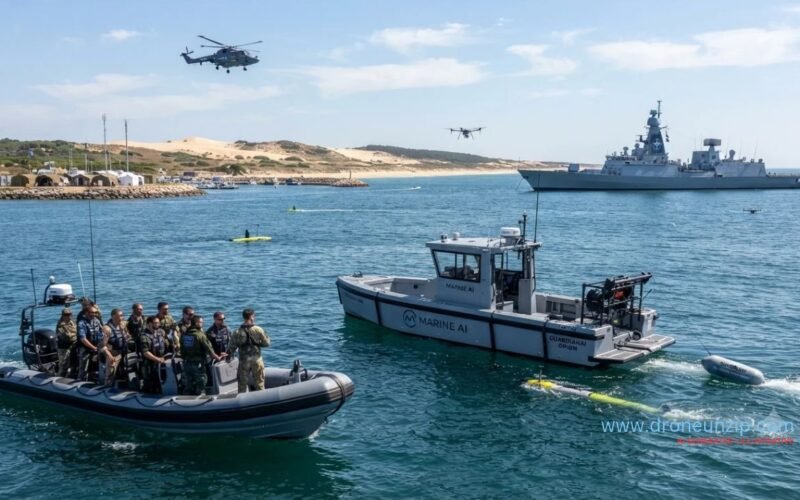
British autonomy developer Marine AI has outlined maritime demonstrations conducted during the REPMUS 2026 exercise in Portugal, including automated deployment of variable-depth sonar and the handling of live NATO mission tasking by unmanned surface vessels.
Key takeaways
- The technical account, reported by Janes, describes Marine AI’s GuardianAI Orion software and operations involving an Oceanus unmanned surface vessel. The company also reported deployment of 40 acoustic sonobuoys during the exercise.
- The demonstration took place earlier in 2026, with the technical details subsequently reported. It should therefore be presented as newly disclosed exercise results rather than a November sea trial.
What happened
The technical account, reported by Janes, describes Marine AI’s GuardianAI Orion software and operations involving an Oceanus unmanned surface vessel. The company also reported deployment of 40 acoustic sonobuoys during the exercise.
The demonstration took place earlier in 2026, with the technical details subsequently reported. It should therefore be presented as newly disclosed exercise results rather than a November sea trial.
Technical and operational context
Anti-submarine surveillance depends on more than navigating without a crew. Surface vessels must coordinate sensors, maintain mission communications, position acoustic equipment and pass useful observations to a wider command network.
The company’s claims suggest progress toward integrated uncrewed maritime missions, but the reports do not independently establish the reliability of every automated function in contested conditions or support an unqualified world-first claim.
Why it matters and what comes next
Future opportunities include autonomous sonar deployment, interoperability with naval command systems, remote payload management and distributed acoustic surveillance. Operational adoption will require repeatable trials, safety validation and performance data.
