

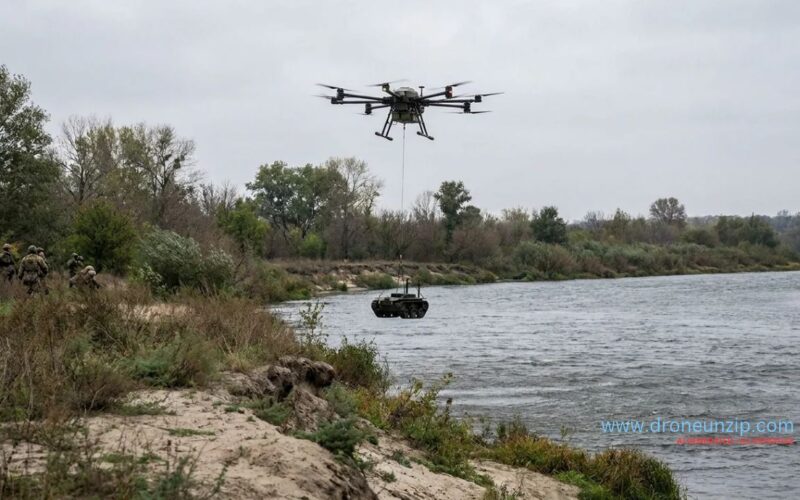
Ukraine’s Navy says personnel from the 426th Separate Unmanned Systems Regiment used a heavy aerial drone to transport an explosive ground robot across the Dnipro River to the Russian-held bank in the Kherson region. The military described the operation in statements reported on 12 November, presenting it as a combined mission involving airborne reconnaissance, attack drones and an unmanned ground vehicle.
What happened
According to the Ukrainian account, a Perun aerial drone carried a small ground robot fitted with a seven-kilogram explosive charge. The vehicle was released on the opposite riverbank and reportedly retained communications and control after landing.
The Ukrainian Navy said the ground vehicle then travelled toward a building used by Russian drone operators. Reconnaissance and FPV-drone crews reportedly supported the mission, including strikes against other positions observed during the ground robot’s movement. Ukrainian officials claimed that the ground vehicle was detonated at its target and that the position was destroyed.
Operational context and verification
The reported target damage, precise sequence and absence of Ukrainian casualties have not been independently verified. The operation’s description is attributable to Ukrainian military sources; it should not be treated as independently established battlefield fact.
The distinction between remote control and autonomy is also important. Reports describe a vehicle maintaining operator control after landing, but do not establish that it independently selected its route or target. The mission therefore demonstrates a reported air-delivery concept, not proven fully autonomous cross-domain combat.
Why it matters and what comes next
An aerial carrier could allow a ground robot to bypass a river or other obstacle without requiring a bridge or a long approach route. That combination is potentially useful for reconnaissance, inspection and other tasks in areas where the terrain prevents ordinary ground access.
The emerging engineering challenges include payload weight, safe aerial release, post-landing connectivity and coordination between different control teams. The event is a reported operational example; broader claims that this tactic is unprecedented or repeatable at scale require further evidence.
For context, DroneUnzip has previously covered Ukraine’s expanding ground-robot operations and European robotic ground-force trials.
