

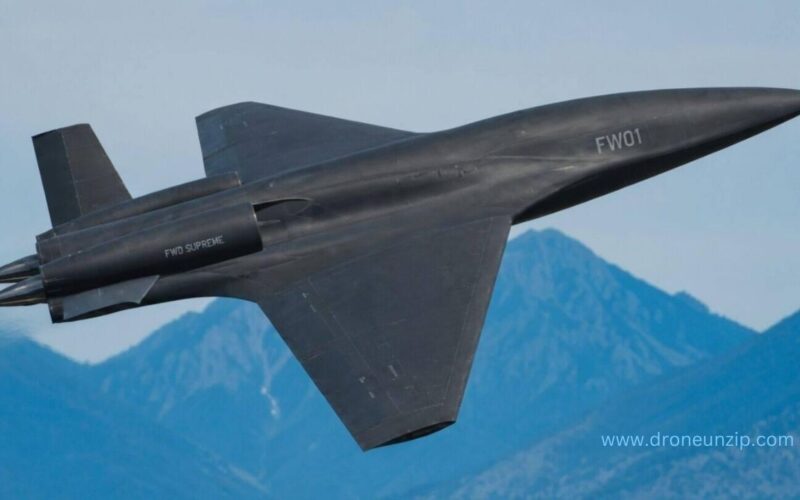
Flying Wedge Defence & Aerospace (FWDA), a Bengaluru-based defence technology company, unveiled a full-scale static prototype of its FWD Supreme AI-piloted combat aircraft in New Delhi on 13 October 2026. The display marks a visible development milestone for the company’s autonomous-aircraft programme, but it does not demonstrate that the aircraft has flown or achieved operational combat capability.
FWDA is presenting FWD Supreme as a family of aircraft intended to use onboard autonomy and coordinate with other aircraft. The company’s claims about range, speed, payload and future missions remain programme targets unless confirmed through disclosed flight tests or independent evidence.
What was unveiled in New Delhi?
On 13 October, FWDA displayed the full-scale static prototype of FWD Supreme. Reporting by The Times of India and India Sentinels described the event as the public presentation of the aircraft and the company’s broader plans for an AI-piloted aircraft family.
A static prototype can help communicate an aircraft’s intended shape, size and design direction. It is not equivalent to a flying demonstrator: it cannot, by itself, verify handling, propulsion performance, autonomous flight, sensor integration or mission reliability.
What is FWD Supreme designed to do?
FWDA describes FWD Supreme as an AI-piloted combat-aircraft programme built around what it calls a “Mobbing Doctrine”: multiple autonomous aircraft would operate as a coordinated force rather than relying on a single expensive platform. The concept is intended to combine networked autonomy with a lower-cost approach to future combat-aircraft mass.
The company’s public materials describe autonomous navigation and mission execution as central ambitions. These are design goals, not proof that the system can safely or reliably perform every task without human oversight. Publicly available information reviewed for this report does not establish the programme’s final command-and-control architecture, operational rules or validated autonomy envelope.
FWD Supreme Lite and Supreme Heavy: the planned variants
Coverage of the programme describes two planned aircraft classes: the smaller FWD Supreme Lite, intended as a technology demonstrator, and the larger FWD Supreme Heavy, envisioned for more demanding missions. The company has described Supreme Lite as the initial step towards testing technologies that could support the broader programme.
FWD Supreme Lite: media reports have placed this demonstrator in the approximately 250-kilogram class. The intended role is to validate technologies and flight concepts before any wider conclusions can be drawn about the larger aircraft. A stated target date for a first flight should not be read as confirmation that the flight has taken place.
FWD Supreme Heavy: the larger aircraft has been described in reporting as a roughly one-tonne-class design intended for intelligence, surveillance and reconnaissance (ISR), strike and collaborative-combat roles. These are intended roles, not publicly demonstrated mission capabilities.
What performance figures have been reported?
Different reports have cited performance goals for the FWD Supreme family, including high subsonic speed and long-range operation. Figures vary by variant and source. Because the full-scale aircraft shown in October was a static prototype, those numbers should be presented as design targets or company-reported specifications, not measured flight performance.
| Programme detail | Publicly reported information | Evidence status |
|---|---|---|
| October 2026 reveal | Full-scale static prototype displayed in New Delhi | Reported event; not a flight demonstration |
| FWD Supreme Lite | Approximately 250 kg-class technology demonstrator | Reported programme description |
| FWD Supreme Heavy | Approximately one-tonne-class planned variant | Design ambition; operational capability not demonstrated publicly |
| Speed and range | Various targets reported by media and company materials | Not independently verified through disclosed flight-test data |
| Coordinated autonomy | Company describes multiple aircraft operating together | Concept and development goal; public operational validation not established |
How does the programme fit India’s drone and aerospace industry?
FWD Supreme is part of a wider shift in defence aviation towards uncrewed aircraft, collaborative combat concepts and software-intensive autonomy. For India, such programmes could create opportunities in airframe design, propulsion, avionics, flight-control software, sensors and systems integration. However, a displayed prototype is an early programme milestone; manufacturing readiness and credible operational capability require further development and testing.
DroneUnzip has previously covered FWDA’s Portugal manufacturing partnership and India’s Ghatak UCAV programme. These programmes are not interchangeable: they differ in maturity, intended role and public evidence. Keeping those distinctions clear helps readers assess announcements without treating every concept as a near-term capability.
What remains unproven?
The public material reviewed does not establish that the FWD Supreme full-scale prototype has flown. Nor does it independently verify the programme’s proposed speed, range, payload, autonomy performance, coordinated operations or combat effectiveness. The status of the smaller demonstrator should be checked against a dated company statement before reporting any first-flight milestone as completed.
Further milestones to watch include a confirmed first flight, disclosed test objectives and results, repeatable autonomous flight demonstrations, evidence of system integration and clarity on the path from technology demonstrator to a production aircraft. Until such evidence is available, FWD Supreme is best described as an ambitious Indian development programme rather than an operational AI fighter.
Conclusion
The unveiling of FWD Supreme gives India’s autonomous-combat-aircraft ambitions a tangible public prototype. The significance lies in the programme’s next steps, not in assuming that a static display proves flight or combat performance. Verified test milestones, transparent technical evidence and progress from the smaller demonstrator will show how far the concept advances beyond its current stage.
FAQs
What is FWD Supreme?
FWD Supreme is an AI-piloted combat-aircraft programme being developed by Bengaluru-based Flying Wedge Defence & Aerospace.
Has FWD Supreme flown?
The full-scale aircraft unveiled on 13 October 2026 was reported as a static prototype. The public evidence reviewed for this article does not verify a flight by that full-scale aircraft.
What is FWD Supreme Lite?
FWD Supreme Lite is the smaller technology demonstrator intended to validate parts of the broader programme before the larger variant advances.
What is FWD Supreme Heavy intended for?
Public reports describe the planned larger variant as intended for ISR, strike and collaborative-combat roles. These remain programme intentions until supported by testing and further evidence.
Are the reported speed and range confirmed?
No independent flight-test data supporting the programme’s reported performance targets was identified for this article. Figures should be attributed to the company or the specific report that published them.
