

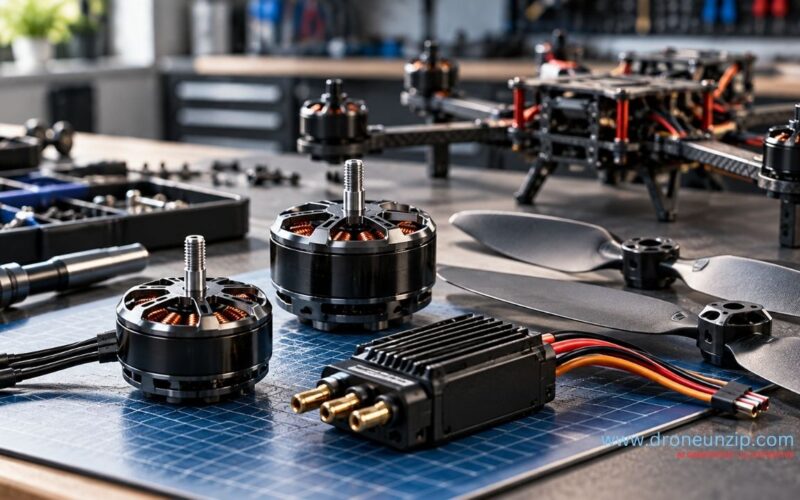
A drone motor does more than spin a propeller. It turns electrical energy from the battery into rotation and thrust, while the flight controller and electronic speed controller (ESC) continually adjust motor output to keep the aircraft stable and responsive. Choosing the right motor means matching it to the drone’s size, propellers, battery voltage, expected load and flight purpose, not simply buying the highest KV rating.
This guide explains the main drone motor types, how to read KV ratings, what ESCs do, and the checks that matter when selecting or replacing a motor. It focuses mainly on electric multirotors, while noting where fixed-wing drones differ.
What is a drone motor?
A drone motor is the propulsion component that rotates a propeller to generate thrust. On a multirotor, the flight controller changes the speed of individual motors to control lift, roll, pitch and yaw. A quadcopter generally uses four motors, while larger multirotors may use six, eight or more. A fixed-wing drone may use one or more motors to provide forward thrust, with wings producing most of the lift.
Most modern multirotors use electric brushless motors because they offer a useful balance of power, efficiency, weight and durability. The motor is only one part of the propulsion system: its performance depends on the propeller, battery, ESC, cooling and aircraft design.
Brushed vs brushless drone motors
| Type | How it works | Typical use | Trade-off |
|---|---|---|---|
| Brushed DC | Mechanical brushes switch current through the motor windings. | Some inexpensive toy and very small micro drones. | Simple control and low cost, but brushes wear and efficiency is generally lower. |
| Brushless DC (BLDC) | An electronic controller switches current through motor windings to drive a permanent-magnet rotor. | Most camera, FPV, mapping and industrial multirotors. | Efficient and capable, but requires a compatible ESC and correct setup. |
“Brushless” does not automatically mean a motor is suitable for every drone. Motor size, winding design, rated voltage, current, cooling, shaft and mounting dimensions all matter. For replacement, match the exact motor specification where possible rather than relying on appearance alone.
How a brushless drone motor works
In a typical outrunner motor, the outer bell containing permanent magnets rotates around stationary copper windings. The ESC energizes the windings in sequence, creating a rotating magnetic field that turns the bell and the attached propeller. Many multirotor motors are outrunners because their design can deliver useful torque in a compact package.
The flight controller does not usually power the motor directly. It calculates the corrections needed for stable flight and sends commands to the ESCs. The ESCs then regulate the electrical power delivered to each motor. This is why motor, ESC, battery and flight-controller compatibility should be considered as one system.
What does a drone motor KV rating mean?
Motor KV is the approximate no-load rotational speed per volt, expressed as RPM per volt. It is not kilovolts, and it is not a direct measure of motor power. As a simplified illustration, a motor rated at 1,000 KV supplied with 10 volts has a theoretical no-load speed near 10,000 RPM. Under a propeller load, actual speed is lower and depends on the motor, voltage, propeller and operating conditions.
Higher-KV motors tend to turn faster at a given voltage and are often paired with smaller propellers. Lower-KV motors are commonly used with larger propellers and higher-voltage systems. These are design tendencies, not universal rules: compare manufacturer test data for the exact motor, battery and propeller combination.
| Selection factor | What to check | Why it matters |
|---|---|---|
| KV rating | RPM per volt and manufacturer test tables | Helps indicate the motor’s speed range with a given battery. |
| Stator dimensions | Motor size code and physical measurements | Influences torque capability, weight and fit, but is not a complete performance rating. |
| Voltage / cell count | Supported battery voltage | Exceeding the specified voltage can damage the motor or connected electronics. |
| Current and power | Continuous and peak limits, with stated test duration | Helps match the ESC, wiring and battery to the expected load. |
| Propeller | Diameter, pitch, blade count and manufacturer recommendations | A different propeller can change current draw, thrust, heat and efficiency substantially. |
What is an ESC, and how does it work with the motor?
An electronic speed controller converts the battery’s DC supply into the controlled phase currents needed by a brushless motor. It receives commands from the flight controller and adjusts motor output. ESC specifications commonly include supported battery voltage, continuous current rating, short-duration peak current, cooling requirements and supported control protocols.
Choose an ESC based on the motor’s measured or manufacturer-published current draw with the intended propeller and battery, while following the manufacturer’s recommended safety margin. A headline amp rating alone is not enough: voltage support, cooling, installation and the duration attached to a peak rating matter too. The ESC must also be compatible with the flight controller and wiring arrangement.
Matching a motor, propeller and battery
These components form a system. A larger or higher-pitch propeller can demand more torque and current; a higher battery voltage can raise motor speed and power demand; and a different motor winding changes the response. Because battery voltage and discharge capability directly affect propulsion choices, review our drone battery guide alongside the motor manufacturer’s test data. A combination that produces impressive thrust in a short test may run hot or be inefficient in sustained flight.
- Start with the aircraft: establish frame size, all-up weight, payload and intended flight style.
- Use manufacturer data: review thrust, current, power and efficiency tables for the exact motor-propeller-voltage combination.
- Check the whole power path: verify the ESC, battery discharge capability, connectors and wire ratings against the expected current.
- Allow for heat: consider airflow, ambient temperature and whether a published peak rating is only valid for a few seconds.
- Test conservatively: follow the motor and ESC manufacturers’ instructions, secure the aircraft, remove propellers for bench motor tests where appropriate, and never handle a powered propeller.
Tools such as ArduPilot’s Drive Calculator guide can help compare candidate motor, propeller and battery combinations. Calculations are estimates, so use the correct component data and validate the setup safely.
How to choose a drone motor for different uses
| Use case | Priorities | Common mistake |
|---|---|---|
| Small indoor or toy drone | Low weight, physical fit, low power demand and easy replacement | Buying a motor based on size alone without checking the original specification. |
| FPV racing or freestyle | Fast response, suitable KV for the battery and propeller, durability and adequate cooling | Choosing the highest KV available without checking current draw and prop compatibility. |
| Camera or mapping multirotor | Efficiency, smooth control, useful thrust margin, reliability and flight time. These priorities matter alongside the imaging needs covered in our drone camera buying guide. | Optimizing for peak thrust while ignoring hover efficiency and temperature. |
| Industrial or payload-carrying drone | Documented thrust data, thermal limits, reliability, redundancy requirements and serviceability | Assuming hobby-grade specifications transfer directly to a heavier aircraft. |
| Fixed-wing UAV | Motor and propeller matched for forward thrust, airframe and flight speed | Applying multirotor motor-selection assumptions without accounting for the wing and flight profile. |
There is no single best KV or motor size for all drones. The right choice is the one supported by data for the specific aircraft and mission. For example, an FPV build may prioritize quick throttle response and agility, so start by understanding what an FPV drone is and how it is used before comparing motor and propeller combinations.
Signs a drone motor may need attention
Warning signs include unusual grinding or clicking, rough rotation, excessive heat, visible damage, a bent shaft, inconsistent motor response or a smell associated with overheated insulation. These symptoms can also arise from a damaged propeller, loose mounting, bearing wear, ESC faults or wiring problems, so diagnose the full propulsion chain rather than automatically replacing the motor.
Before inspection, disconnect the battery and remove propellers. Do not continue flying a drone that shows abnormal vibration, damaged wiring or repeated motor desynchronization. Follow the manufacturer’s maintenance guidance and replace components that are outside their service limits.
Common mistakes when selecting drone motors
- Treating KV as power: KV describes speed per volt, not watts, thrust or overall quality.
- Ignoring the propeller: the same motor can draw very different current with different propellers.
- Oversizing the ESC by one number alone: voltage support, real current demand and cooling still need checking.
- Mixing incompatible components: confirm mounting, shaft, connectors, voltage and controller compatibility.
- Using peak ratings as continuous ratings: note test duration and cooling conditions in manufacturer specifications.
- Skipping post-repair checks: inspect mounting, wiring, propeller direction and flight-controller motor order before flight.
FAQs
Is a higher-KV drone motor always more powerful?
No. KV is an approximate speed-per-volt constant. Power and thrust depend on the complete motor, propeller, battery and ESC combination, as well as thermal limits.
Can I use any ESC with a brushless drone motor?
No. The ESC must support the battery voltage, expected current, motor type and control interface. Use the motor manufacturer’s propulsion data and the ESC’s continuous and peak ratings to confirm compatibility.
Do all drones use brushless motors?
No. Some inexpensive toy and micro drones use brushed motors. Brushless motors are common in larger and performance-oriented multirotors because of their efficiency and durability advantages.
How do I know whether a replacement motor will fit?
Check the manufacturer’s part number, stator dimensions, mounting-hole spacing, shaft diameter, voltage and KV rating, connector and recommended propeller. Similar-looking motors are not necessarily interchangeable.
What is the safest way to test a new motor?
Follow the manufacturer’s instructions and perform initial checks with the propellers removed wherever appropriate. Secure the aircraft, verify motor order and direction, inspect wiring and keep hands and loose objects away from rotating parts. Install propellers only for a controlled test in a suitable area.
Conclusion
Drone motor selection is a matching exercise, not a race to the highest KV or largest amp rating. Understand the motor type and KV, then check manufacturer data for the exact battery and propeller, confirm ESC and wiring limits, and account for cooling and the aircraft’s real load. This system-level approach helps produce a drone that is safer, more reliable and better suited to its intended job.
