
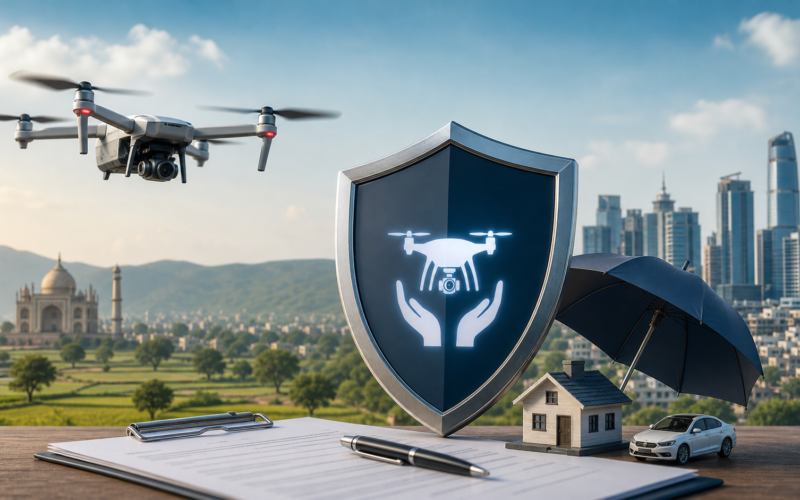
Drone insurance in India is not simply an optional warranty for a damaged aircraft. Rule 44 of the Drone Rules, 2021 applies the Motor Vehicles Act, 1988 framework, with necessary modifications, to third-party drone insurance and compensation for injury or property damage. The rule expressly allows a nano drone to operate without third-party insurance. Cover for damage to your own drone is a separate buying decision.
This guide explains what the rules say, what insurers actually offer, and how to evaluate cover without confusing third-party liability with protection for the drone itself. Policy availability, eligibility and prices depend on the insurer’s current terms.
Is drone insurance mandatory in India in 2026?
For drones other than nano UAS, treat third-party liability insurance as a regulatory requirement and verify the current rules and your operation with the insurer and DGCA. Rule 44(1) incorporates the Motor Vehicles Act framework for third-party insurance and compensation, while its proviso states that a nano UAS may operate without third-party insurance. The Ministry of Civil Aviation’s regulatory explanation and India’s submission to ICAO likewise describe third-party cover as mandatory outside the nano category.
The official Drone Rules, 2021 are the starting point. Read the current amendments and official notices before relying on this explanation for a particular operation. A policy does not replace UIN registration, pilot qualification or airspace permissions where those are required.
Third-party liability versus drone hull insurance
| Type of cover | What it is designed to address | Important limitation |
|---|---|---|
| Third-party liability | Covered legal liability arising from injury, death or property damage to other people | It generally does not pay to repair your own drone |
| Hull or physical-damage cover | Covered damage to the insured aircraft, and sometimes declared spares or payload | Deductibles, exclusions and agreed-value limits apply |
| Operator accident/medical cover | Specified injuries or medical expenses of the authorised operator | Not automatically included in every plan |
| Optional endorsements | Selected risks such as transit, night operations, BVLOS, theft or disappearance | Only if expressly included and permitted under the policy and law |
For example, ICICI Lombard’s drone insurance information distinguishes standalone third-party liability from hull-and-liability cover. Oriental Insurance’s UAV UDAN literature lists third-party, hull and spares protection as separate sections. These are examples of product structures, not endorsements or guaranteed coverage for every buyer.
What does drone insurance usually cover?
A liability section may respond to a covered accident in which a drone damages a parked vehicle or injures a bystander, subject to policy terms and the insured’s legal liability. Hull cover may respond to an insured crash or physical damage to the aircraft. Additional protection for ground equipment, transit, theft, operator injuries or other risks depends on the selected policy and endorsements.
Scenario: A surveying drone clips a structure and falls onto a parked car. Third-party liability may address the covered claim for the car. Repairs to the surveying drone would ordinarily need a separate hull section. Neither payout should be assumed without checking exclusions, deductibles, limits and the circumstances of the flight.
What may be excluded?
Read the complete policy wording, not just the marketing page. Pay particular attention to authorised operators, permitted operations, geographic territory, required registration or certification, policy start and end times, declared equipment, deductibles, and endorsements for unusual missions. Unlawful or unauthorised operations may create serious coverage problems.
IFFCO-Tokio’s published Drone Rakshak policy wording illustrates why the full document matters: it separates third-party liability, physical damage and operator covers and contains general exclusions, conditions and optional endorsements. Always check the wording for the exact product and policy year offered to you.
How much does drone insurance cost in India?
There is no reliable universal premium for every drone. The quote can change with the insured aircraft and equipment value, third-party liability limit, usage, location, operator experience, claims history, coverage duration, deductible and add-ons. Oriental Insurance’s published literature specifically identifies agreed drone/spares values and the chosen third-party liability sum insured as premium factors.
Rather than trust an unsourced price range, request comparable written quotes for the same drone, operation, liability limit and hull value. Compare total payable premium, deductible, exclusions, coverage period and claim limits. A cheaper policy with a large deductible or missing operational endorsement may be less useful after an accident.
Can you buy insurance for a hobby or nano drone?
Rule 44 provides a third-party insurance exemption for nano UAS; it does not prohibit an owner from seeking optional protection. Whether a particular hobby drone can be insured depends on the insurer’s underwriting and eligibility criteria. Some products are designed for retail as well as commercial users, but a seller’s product page is not proof that your specific aircraft qualifies.
For a beginner, the practical question is not only whether insurance is required. It is also whether the drone is lawfully operable, whether its serial numbers and registration details meet underwriting requirements, and whether the policy covers the way you actually fly.
What should photographers, farmers and commercial operators check?
Photography and filmmaking
Check third-party limits, whether flights at client sites are covered, who is an authorised operator, and whether cameras and payloads are declared. Do not assume a standard policy covers every location or event.
Agricultural spraying
Disclose the agricultural operation and any chemical or spraying-related exposure. Ask whether drift, crop damage, payload and specialist liability are covered or excluded. General hull insurance does not automatically insure every agricultural loss.
Mapping, inspection and industrial use
Confirm site-specific operating conditions, high-value payloads, proximity to third-party property, contractual insurance limits and whether multiple pilots or aircraft can be listed.
Drone training and fleets
Check training-flight eligibility, named operators, fleet schedules and whether short-term or annual cover is appropriate. ICICI Lombard describes fleet and short-term possibilities, subject to its underwriting terms.
Annual insurance versus short-duration cover
Some Indian drone products offer annual and shorter-duration options. Oriental Insurance’s UAV UDAN literature describes annual, short-period and pay-as-you-fly formats, including time-limited flight cover. These are insurer-specific offerings, not a promise that every applicant can buy an hourly policy. Check when cover starts and whether preflight setup, transport or storage is included.
How to compare drone insurance policies: a checklist
- Identify the exact drone, maximum take-off weight, UIN and certification status where applicable.
- Describe your real operations accurately: hobby, filming, mapping, spraying, inspection or training.
- Choose an appropriate third-party liability limit and check whether clients require a higher limit.
- Decide whether hull, payload, spares, theft, transit or operator accident cover is worth adding.
- Compare deductibles, exclusions, authorised-pilot conditions and territorial limits.
- Ask the insurer about claims notification deadlines, required evidence and repair or replacement valuation.
- Keep the final policy schedule, wording, endorsements and insurer contact details accessible during operations.
What to do after a drone accident
First protect people and follow emergency procedures. Do not create additional danger while recovering equipment. Record the incident location, date, operator, flight logs, photographs, witness details and damage where safe and lawful. Notify the insurer promptly within the policy’s deadline, and comply with any applicable reporting obligations to authorities. Avoid admitting or settling third-party liability on the insurer’s behalf without reviewing policy conditions and obtaining appropriate advice.
Registration, airspace and insurance are different checks
Insurance cannot legalise a prohibited flight. Read our drone registration in India guide for UIN and eGCA context, our airspace map guide before choosing a location, and our drone flying licence guide for pilot-related requirements. Buyers can also use our drone price guide to think about equipment replacement costs.
FAQs
Is third-party drone insurance compulsory?
Rule 44 applies the third-party insurance framework and specifically permits nano UAS to operate without third-party insurance. Verify the current rules and applicable requirements for your aircraft and operation.
Does third-party insurance pay for my crashed drone?
Normally no. Damage to your own drone generally requires hull or physical-damage cover.
Are cameras and batteries insured automatically?
Not necessarily. Check whether the payload, accessories, batteries and spares are listed and covered under the policy schedule.
Is drone insurance available for one day?
Some insurers describe short-duration products. Availability, minimum period, eligibility and add-ons depend on the current policy.
Can I fly in a red zone if I have insurance?
No. Insurance does not replace airspace authorisation or any other legal requirement.
