

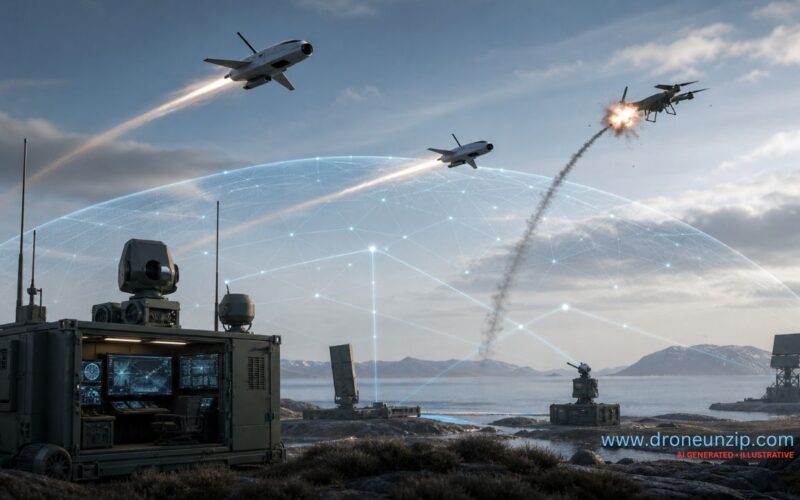
German defence technology company Helsing has introduced Contra, an AI-enabled air-defence architecture designed to respond to mass drone and missile threats.
What happened?
The October 26 announcement includes two interceptor concepts, the jet-powered AD-1 Inferno and rocket-powered AD-2 Ambush, as elements of a coordinated defensive system.
Why this development matters
The programme reflects an increasingly important problem: inexpensive attacking drones can force defenders to expend comparatively costly interceptors. Systems combining sensing, decision support and lower-cost interception aim to change that equation.
Emerging technology and industry opportunities
For the unmanned-systems industry, the opportunity spans interceptor propulsion, sensor integration, software-based threat prioritisation and distributed command networks.
What remains unconfirmed?
Manufacturer announcements do not independently prove engagement success, operational reliability, cost per interception or combat readiness. Those claims should be assessed when test results and customer deployments become public.
FAQs
Is this technology already operational?
The announcement alone does not confirm a fully operational deployment. Specific fielding and validation milestones must be verified separately.
What should industry observers watch next?
Watch for independently documented trials, technical specifications, procurement decisions and deployment milestones.
