
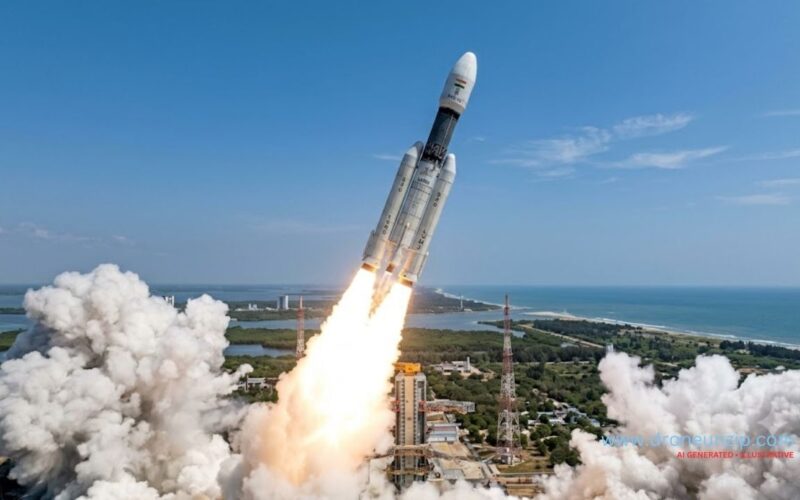
India’s space agency ISRO is preparing to launch its NVS-03 navigation satellite aboard GSLV-F18 at 11:51 p.m. IST on 30 October 2026 from Sriharikota, in a mission intended to strengthen the country’s NavIC positioning, navigation and timing system. The satellite has not yet launched, and its eventual contribution depends on successful orbit-raising and commissioning.
Key Takeaways
- ISRO has scheduled GSLV-F18/NVS-03 for 30 October at 11:51 p.m. IST.
- The second-generation satellite carries an indigenous atomic clock and adds an L1 navigation signal alongside L5 and S bands.
- NavIC’s operational constellation has been weakened by ageing satellites and the NVS-02 orbit-raising failure.
- A launch success will not by itself prove that full, standalone NavIC navigation has been restored.
Who Is Conducting the NVS-03 Mission?
The Indian Space Research Organisation is conducting the mission using its Geosynchronous Satellite Launch Vehicle. ISRO describes GSLV-F18 as the vehicle’s 20th flight. NVS-03 is the third satellite in a planned second-generation series designed to continue services originally provided by the Indian Regional Navigation Satellite System, now known as NavIC.
What Will NVS-03 Carry Into Orbit?
According to ISRO, NVS-03 carries an Indian-developed atomic clock together with procured clocks and supports L1 navigation signals in addition to the established L5 and S bands. The satellite is intended to support positioning, navigation and timing services across India and a region extending approximately 1,500 kilometres beyond its geopolitical boundary. GSLV-F18 will initially place the spacecraft into a geosynchronous transfer orbit, after which further manoeuvres are required.
When and Where Is the Launch Planned?
The launch is scheduled for Friday, 30 October 2026, at 11:51 p.m. IST from the Second Launch Pad at the Satish Dhawan Space Centre, Sriharikota, Andhra Pradesh. That is a scheduled time, not a completed event; launch plans may change for technical or weather reasons.
Why Does NavIC Need Reinforcement?
India’s navigation constellation has suffered setbacks. NVS-02 reached space in January 2025 but failed to complete its orbit-raising manoeuvres. ISRO’s investigation identified a problem in the signal path to a pyro valve associated with the propulsion system. The agency says corrective measures were implemented for the subsequent mission. Meanwhile, ageing spacecraft have reduced the number of satellites providing operational navigation services. The immediate task is restoring a sufficiently capable constellation, not merely adding another spacecraft to orbit.
What Could This Mean for Indian Drones and Autonomous Systems?
Satellite positioning is an important input for drone flight control, ground robotics and unmanned maritime navigation. A healthier NavIC system could strengthen options for Indian navigation-receiver makers and system integrators, particularly where domestic positioning infrastructure is strategically valuable. This is an industry implication rather than a demonstrated improvement in drone performance. India is also building broader indigenous unmanned capabilities through the Indian Air Force’s unmanned-systems roadmap, although that programme is separate from the ISRO launch.
What Happens After Liftoff?
The key milestones will be successful satellite separation, orbit-raising, clock and signal validation, and commissioning into NavIC service. Further replenishment missions are expected to be necessary for a resilient constellation. Drone manufacturers should monitor receiver compatibility and real-world service availability rather than assume the new satellite immediately changes field operations.
Sources: ISRO official mission page; The Indian Express; The Times of India
