

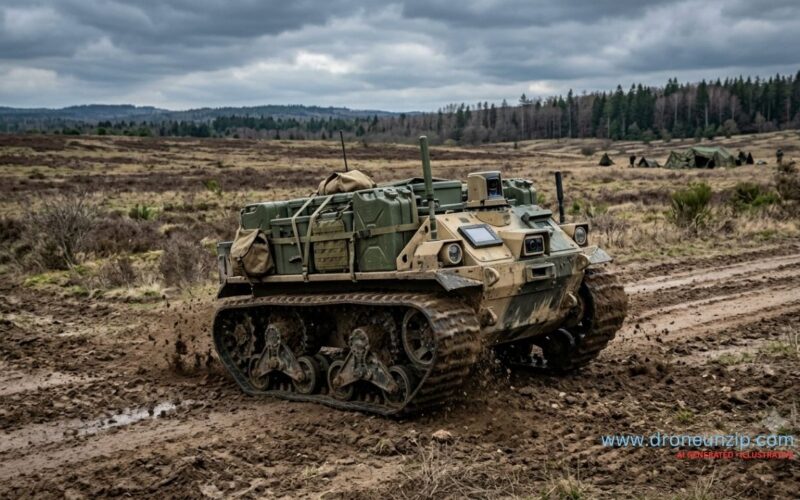
Ukraine’s Lava Unmanned Systems Regiment says a ground robot completed approximately 93% of a 20-kilometre battlefield supply mission without direct driving by a human operator, marking a reported step towards supervised autonomous logistics. The claim was publicised on 28 October 2026 and has not been independently validated under controlled test conditions.
Key Takeaways
- The unit reports roughly 20 kilometres of travel, with human intervention for 1.4 kilometres.
- A separate robotic platform first scanned the route using LiDAR to create a three-dimensional map.
- The supply robot used cameras and AI software to follow the mapped route and recognise obstacles.
- The reported mission supports a supervised-autonomy model, not fully independent navigation in every environment.
Who Conducted the Autonomous Ground Robot Mission?
The Lava Unmanned Systems Regiment, part of Ukraine’s National Guard’s Khartiia formation, reported the mission in the Kharkiv sector. Ukrainian reporting identifies Apex AI as the software developer and says the regiment helped define requirements and test the system in the field. The account reflects the unit’s description of the operation.
What Did the Robot Do During the Supply Run?
According to the regiment, the vehicle transported supplies and returned over a route totalling about 20 kilometres. AI-guided navigation covered 93% of the route, while an operator directly controlled the vehicle for approximately 1.4 kilometres. The percentages and distances are consistent with each other but should be treated as reported mission figures, not independent performance certification.
How Did LiDAR Mapping and Camera Navigation Work Together?
Before the supply mission, a different robotic vehicle surveyed the route using LiDAR and created a three-dimensional model of the terrain. The logistics robot then followed that map, using onboard cameras to identify the road, verges and obstacles. AI software assisted navigation, while the operator remained able to intervene. This is a pre-mapped autonomy approach, not evidence that the robot could navigate an unfamiliar battlefield without prior reconnaissance.
When and Where Was the Mission Reported?
Ukrainian news outlet LB.ua reported the unit’s account on 28 October 2026, locating the activity in the Kharkiv operational sector. The publicly available account does not provide a detailed timestamp for the journey or a complete independent dataset covering weather, speed, terrain and communication conditions.
Why Does Supervised Autonomy Matter?
Continuous teleoperation can burden operators and become unreliable when communications are interrupted. The regiment says its longer-term objective is to shift the human role from constant driving to supervising several vehicles and intervening only when necessary. The approach is part of a wider move towards coordinated robotic operations; DARPA’s four-vehicle ground autonomy demonstration provides a different example of how teams are exploring coordination and reduced operator workload.
What Comes Next for Battlefield Logistics Robots?
The unit sees casualty evacuation as a possible next application, but a logistics demonstration does not establish medical evacuation readiness. Key questions include repeatability, obstacle avoidance around people, operation when maps become outdated, resilience under jamming and how many vehicles one operator can safely supervise. These are the tests that would determine whether the reported milestone can scale.
Sources: LB.ua; Business Insider
