

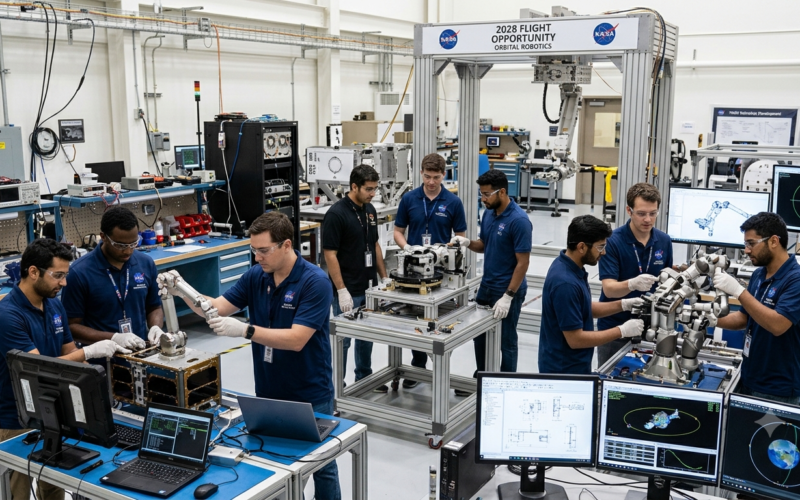
NASA has selected three teams to develop payloads that can be handled or reconfigured by a robotic arm in orbit, advancing a programme aimed at making future spacecraft easier to inspect, upgrade and service.
The selections, announced on October 2, 2026, form part of NASA’s Robotically Manipulated Payload Challenge under the TechLeap Prize programme. Each team is eligible for up to $500,000 to develop flight-ready hardware and may receive an orbital demonstration opportunity at no additional cost.
Key Takeaways
- NASA selected three teams for its Robotically Manipulated Payload Challenge.
- Each team can receive up to $500,000 in prize funding, with up to $1.5 million expected across the awards.
- The selected payloads are intended to work with robotic manipulation systems in low Earth orbit.
- NASA currently anticipates payload launches in early 2028, following the planned launch of the Fly Foundational Robots spacecraft in late 2027.
Who Is Behind NASA’s Orbital Robotics Challenge?
NASA’s Space Technology Mission Directorate is using the TechLeap Prize series to encourage private teams to build technologies that can be demonstrated in space. Among the selected entrants listed by NASA are General Galactic Technologies Corporation, with its Theseus Experimental Project, and Falcon ExoDynamics, with its Stowable Mobile Inspection Kit for Close Inspection Operations. NASA’s programme page identifies three awardees in total.
What Will the Selected Payloads Demonstrate?
The challenge calls for equipment that can interact with, be moved by or be reconfigured using a robotic arm in low Earth orbit. NASA describes potential applications including close inspection, deployment of sensors, assembly of structures, material processing and modular systems designed to be swapped or upgraded.
These functions are building blocks for in-space servicing, assembly and manufacturing, often shortened to ISAM. The selected concepts are intended to demonstrate useful robotic interfaces and tasks, not to repair an operational satellite during this competition.
When and Where Are the Demonstrations Planned?
NASA launched the challenge in May 2026 and announced the selected teams on October 2. The agency says the payloads are expected to launch in early 2028 and operate with an orbital spacecraft that will rendezvous with the Fly Foundational Robots spacecraft, itself expected to launch in late 2027.
Those dates are programme plans, not completed launches or confirmed successful demonstrations. The testing is intended to occur in low Earth orbit.
Why Does Robotic Manipulation Matter in Space?
Most satellites are launched as self-contained machines with limited options for repair or modification. Standardised robotic interfaces could eventually make it possible to inspect a spacecraft, replace a failed module or assemble equipment that is too large to launch in one piece.
Such capabilities would require reliable rendezvous, robotic control, object handling and mission assurance. NASA’s challenge focuses on the payload side of that larger problem, rather than claiming that full autonomous satellite servicing has already been achieved.
The initiative sits alongside a wider interest in spacecraft architectures that can evolve after launch. DroneUnzip has previously examined proposals for new orbital infrastructure, although those concepts address different technical challenges.
What Happens Next?
The teams must turn their selected proposals into flight-ready hardware. The most meaningful evidence will come from completed orbital tests showing that the payloads can be handled and operated by a robotic system under spaceflight conditions. NASA’s selection establishes an opportunity and a development award, not a completed demonstration.
