

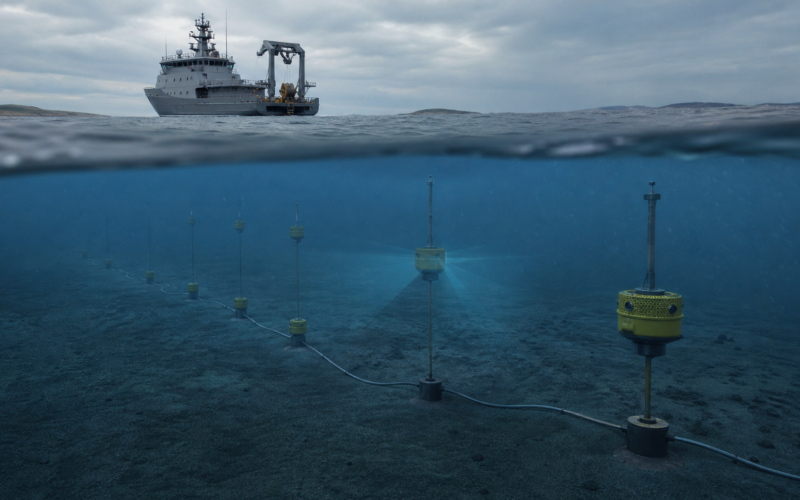
Saab has introduced Ocean Barrier, a modular underwater surveillance system designed to combine data from different sensors and support persistent monitoring of ports, coastal waters and offshore infrastructure. The company announced the system on October 28, 2026, after demonstrating sensor integration and automated track sharing during the REPMUS 2026 maritime exercise in Portugal.
The system’s central proposition is a connected underwater operating picture rather than a single new autonomous vehicle. Saab says Ocean Barrier can combine sensor feeds and hand off tracked contacts to a command system using a NATO-standard protocol.
Key Takeaways
- Saab announced Ocean Barrier on October 28 following a demonstration at REPMUS 2026.
- The system connects diverse underwater surveillance sensors and shares tracked contacts with command systems.
- Saab describes three defensive layers: Detect, Prevent and Protect.
- According to Janes, Saab expects the system to be market-ready in the fourth quarter of 2027.
Who Developed Ocean Barrier?
Swedish defence and technology company Saab developed the system through its underwater systems business. Åsa Schöllin, head of the business unit, described the product as a way to improve maritime awareness and protect economically important sea routes and installations.
What Did Saab Demonstrate at REPMUS 2026?
Saab says Ocean Barrier combined information from different sensor systems and automatically transferred tracked-object information to the exercise’s central command system through a NATO-standard interface. Defence publication Janes reported that the exercise included automatic sensor processing, contact detection and tracking, fusion of above-water and underwater tracks, and transfer of higher-level data through STANAG 4817.
The product is sensor-agnostic, meaning Saab intends it to connect with existing surveillance equipment rather than require every customer to adopt an entirely new sensor suite. Its modular architecture is divided into Detect, Prevent and Protect functions that can be deployed independently or together.
When and Where Was the System Introduced?
Saab publicly launched Ocean Barrier on October 28, 2026. Its technology had been tested during the REPMUS maritime unmanned-systems exercise in Troia, Portugal. The company has not announced that the full system is already deployed across a national maritime surveillance network.
Why Does Networked Underwater Surveillance Matter?
Ports, pipelines, cables and offshore installations are difficult to monitor because underwater sensors operate under very different communications and detection conditions from aerial surveillance systems. Combining separate sensor outputs into a common picture may help operators identify and follow contacts without manually reconciling each feed.
The development fits a wider shift toward interoperability in unmanned systems. DroneUnzip has reported on the Indian Navy’s NAUSETU interface-standards initiative, which likewise puts compatibility between systems at the centre of future operations, although it is a separate programme.
What Happens Next for Ocean Barrier?
Saab’s next challenge is product maturity. Janes reported that some software elements remained at technology-readiness levels six and seven and that the company was targeting the fourth quarter of 2027 for market readiness. The REPMUS demonstration therefore supports a specific integration claim, not a conclusion that the complete system is commercially available or operationally proven.
