

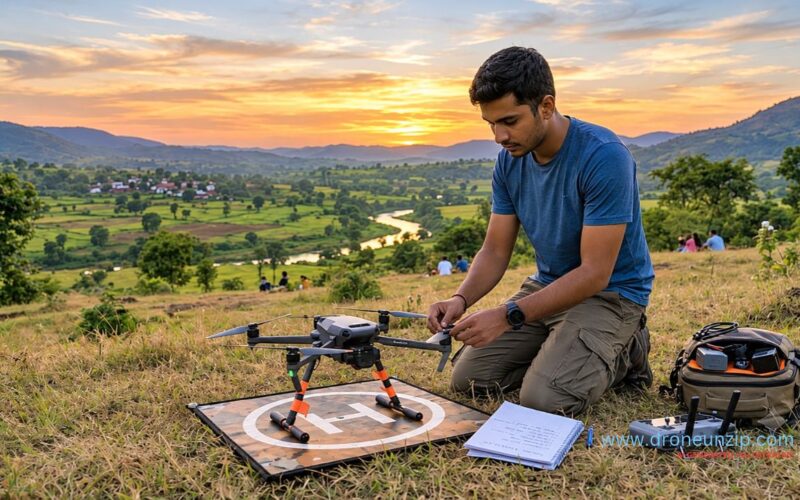
Flying a drone for the first time starts well before takeoff. A damaged propeller, unsuitable flying location, overlooked airspace restriction or incorrectly configured failsafe can turn a short practice flight into an avoidable incident. Drone safety for beginners in India means checking legal requirements, inspecting the aircraft, practising in a suitable area and understanding how to respond to problems.
This practical first-flight guide explains the checks in the order you need them. It is general educational guidance, not permission to fly or a substitute for current DGCA requirements and the manual for your particular aircraft.
Before You Fly: Essential Drone Safety Checklist
| Check | Confirm | Do not fly if |
|---|---|---|
| Legal readiness | Applicable registration, certification and pilot requirements | Permission or eligibility is unclear |
| Airspace | Current Digital Sky zone and authorisations | Required permission is absent |
| Location | Clear takeoff area and separation from people | Hazards cannot be avoided |
| Weather | Wind and visibility within aircraft limits | Conditions are unsuitable |
| Propellers | Correctly fitted and undamaged | Blades are loose or cracked |
| Battery | Secure, healthy and charged | Battery is damaged or abnormal |
| Controller | Reliable link and no critical warnings | Controls are unreliable |
| Safety settings | Home point and failsafe behaviour understood | Recovery settings are uncertain |
1. Check Whether You Can Legally Fly Your Drone in India
India’s Drone Rules, 2021, as amended, address aircraft classification, registration, pilot qualifications and airspace. Your aircraft’s weight, intended use and location all matter. A drone sold as beginner-friendly is not automatically authorised for every operation.
Understand Your Drone’s Weight Category
| Category | Maximum all-up weight including payload |
|---|---|
| Nano | Up to 250 g |
| Micro | Over 250 g to 2 kg |
| Small | Over 2 kg to 25 kg |
| Medium | Over 25 kg to 150 kg |
| Large | Over 150 kg |
Do You Need a Remote Pilot Certificate?
The rules use the term Remote Pilot Certificate. Exemptions apply to nano drones and micro drones used for non-commercial purposes, but these exemptions are not blanket permission to ignore other obligations. Check the applicable requirements for your operation. For registration procedures, see our drone registration guide.
Understand Green, Yellow and Red Airspace Zones
Green zones generally permit qualifying operations without prior airspace permission within applicable limits. Yellow zones require permission from the appropriate air traffic control authority; red zones require Central Government authorisation under the framework. Green airspace is generally defined up to 120 metres above ground level outside restricted areas, with special provisions near operational airports. That is not a recommended first-flight height.
How to Check Your Flying Location
Consult the official Digital Sky airspace map for the intended launch point and flight area. Recheck close to takeoff, since restrictions can change. Relevant regulatory applications are handled through eGCA. A green-zone indication does not grant access to private property or override other site restrictions.
2. Choose a Safe Location for Your First Flight
Find an Open Area With Few Obstacles
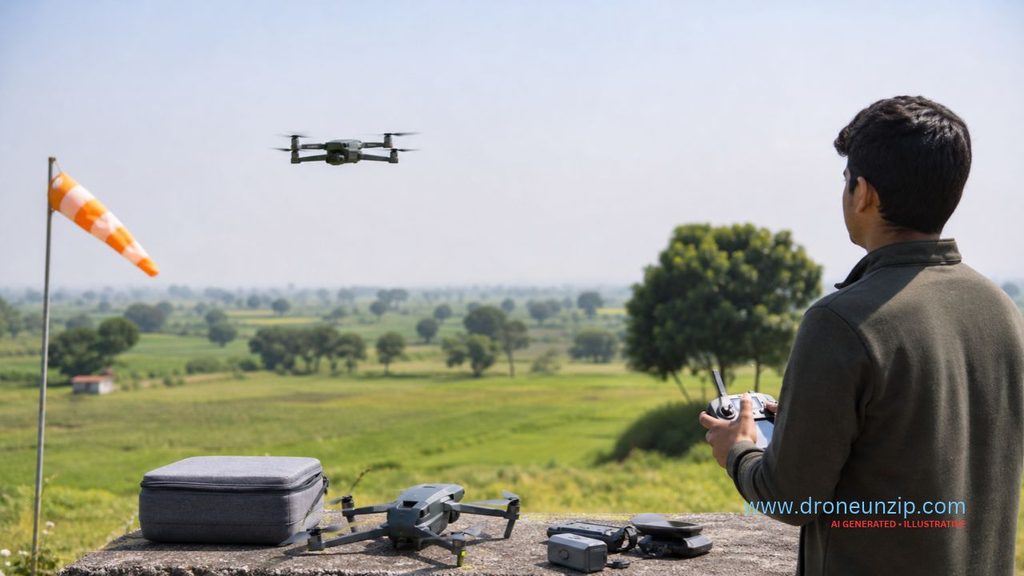
Choose a spacious area with clear visibility, away from trees, buildings, power lines and vehicles. Keep the drone within direct visual line of sight. A simple environment leaves room to correct small mistakes without creating a collision risk.
Keep People Away From the Operating Area
Do not practise over crowds, roads or busy public spaces. Establish a clear launch and landing area and keep bystanders at a safe distance. Even small propellers can injure people.
Check Wind and Visibility
Wind can be stronger above ground level than where you are standing. Follow the manufacturer’s published operating limits and postpone the flight when wind, rain or visibility makes safe control uncertain.
Avoid Complicated Environments
Tall buildings, metal structures and enclosed spaces can complicate positioning or communication. Confirm you are permitted to use the ground location as well as the airspace.
3. Inspect Your Drone Before Takeoff
Inspect Propellers and Motors
Look for cracks, chips, loose fittings and debris. Ensure propellers are correctly installed. Never touch or adjust blades while the aircraft is armed or its motors are running.
Examine the Frame and Landing Gear
Check arms, guards and landing components for damage, particularly after a hard landing. Do not fly with a compromised structural component.
Check Battery Condition
Reject swollen, punctured or otherwise damaged batteries. Confirm that the pack is securely installed and sufficiently charged, including a reserve for landing. Our drone battery guide covers charging and storage in more detail.
Verify Controller and Aircraft Connection
Check controller charge, connection status and warnings. Resolve critical errors before takeoff. Follow the aircraft’s manual rather than assuming the same startup sequence applies to every model.
Check GPS and Return-to-Home Settings
For equipped drones, verify positioning status and the recorded home point. Understand return altitude, obstacle limitations and loss-of-signal behaviour. Not every drone has GPS, and recovery functions differ by model.
4. Your First Drone Flight: A Safe Practice Routine
Prepare for Takeoff
Place the aircraft on a stable, level surface in a clear area. Follow its documented startup procedure, confirm readiness and keep everyone clear of the propellers.
Practise a Low Hover
Take off according to the manual and establish a low, controlled hover appropriate to the surroundings. Observe stability and responsiveness. Land and investigate if the aircraft drifts unexpectedly, vibrates excessively or reports a critical warning.
Learn Forward, Backward and Sideways Movement
Practise gentle, short movements and return to the starting position. When the aircraft faces you, left-right inputs may appear reversed from your perspective. Build orientation skills gradually rather than making abrupt inputs.
Practise Controlled Turns
Try slow turns while keeping the aircraft within the clear practice area. Do not attempt complex manoeuvres until you can reliably judge direction and movement.
Return and Land With Battery Reserve
Return before the battery becomes critical, land in the designated area and follow the shutdown sequence. The goal is a predictable landing, not maximum flight time.
5. What to Do When Something Goes Wrong
If the Drone Starts Drifting
Avoid panicked control inputs. If it remains controllable, move away from people and obstacles and land safely. Investigate wind, positioning or mechanical issues before another flight.
If the Controller Loses Signal
Loss-of-signal behaviour varies. A drone may return home, hover, land or follow a configured failsafe. Learn the model-specific procedure before flying; do not assume automatic return is guaranteed.
If the Battery Becomes Critically Low
Prioritise a safe landing over continuing to film. A nearby suitable landing area may be safer than a long return, depending on the aircraft and conditions.
If You Lose Visual Contact
Do not continue farther away or rely solely on the camera screen. Follow the manufacturer’s documented recovery procedure to re-establish safe control while respecting applicable operating rules.
If the Drone Crashes
Keep bystanders clear. Shut down only when safe. Do not handle a smoking, burning or severely damaged battery. Inspect the aircraft before any further flight and follow applicable incident-reporting requirements. See our DJI troubleshooting guide for model-specific issues.
6. Seven Common Beginner Mistakes to Avoid
Flying Too Far on the First Day
Manufacturer transmission range is not a training target. Keep early flights short and within visual line of sight.
Trusting GPS to Handle Strong Wind
GPS helps positioning but cannot overcome conditions beyond the aircraft’s capabilities.
Ignoring Battery Warnings
Treat warnings as signals to return or land, not invitations to use the last seconds of power.
Flying Close to Trees or Wires
Branches and cables can be difficult to see and detect. Maintain generous clearance.
Assuming Return-to-Home Avoids Every Obstacle
Failsafe behaviour depends on positioning, configuration, battery and sensor coverage.
Flying While Looking Only at the Screen
Maintain visual awareness of the aircraft and surrounding hazards, not just its camera view.
Ignoring Minor Damage After Landing
Inspect small cracks, propeller damage and unusual motor behaviour before the next flight.
7. Drone Safety After Landing
Inspect for Damage
Check the frame, motors and propellers, and remove debris following manufacturer instructions.
Handle the Battery Carefully
Allow cooling when required, use compatible chargers and store batteries at manufacturer-recommended charge and temperature. Never charge a damaged battery.
Review Flight Warnings
Check logs or alerts where supported, and resolve abnormal motor, battery, positioning or communication behaviour.
Store the Equipment Securely
Protect the drone and controller from moisture, impact and excessive heat.
8. A Simple First-Flight Plan for Beginners
Before leaving home: Check regulations, airspace, weather and equipment. At the location: Recheck restrictions, confirm ground access and identify hazards. Before takeoff: Inspect propellers, battery, controller and failsafe settings. During flight: Hover low, practise short movements and maintain visual contact. After landing: Shut down, inspect, review warnings and store the aircraft. This sequence supplements rather than replaces the model-specific checklist.
FAQs
Can beginners fly drones legally in India?
Yes, when the aircraft and operation meet applicable requirements and airspace restrictions.
Do I need a licence to fly a drone under 250 grams?
The Remote Pilot Certificate framework exempts nano drones from that certification requirement, but other applicable rules still matter.
Can I fly in a green zone without permission?
Qualifying operations generally do not need prior airspace permission within applicable limits, but other restrictions may apply.
What is the safest place for a first flight?
A permitted, spacious, visible area away from people and obstacles, after checking the airspace.
How high should a beginner fly?
Begin with a low, controlled hover suitable for the aircraft and environment, not the maximum legal altitude.
Can a drone fly without GPS?
Some models can, but may require more active control. Follow the manufacturer’s instructions.
Is return-to-home guaranteed?
No. It depends on positioning, settings, battery and surrounding obstacles.
What should I do if the drone drifts?
If safe, move clear of hazards, land and investigate before another flight.
Should I fly until the battery is almost empty?
No. Preserve a reserve for returning and landing.
What is the most important safety habit?
Do not take off until the aircraft, location, weather and legal conditions have been checked.
Final Thoughts
Drone safety is not one feature built into an aircraft. It comes from preparation, judgement and predictable habits. Start in a suitable location, learn controls gradually, respect the aircraft’s limitations and take warnings seriously. The best first flight is one completed safely from takeoff to landing.
