

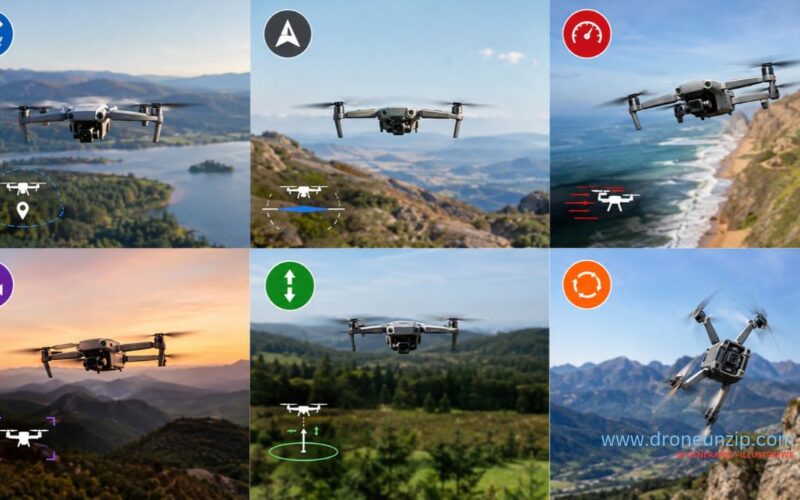
Your controller shows Normal, Sport and Cine. Another drone advertises GPS, Altitude Hold and Headless Mode. These labels sound straightforward, but they do not all describe the same type of control. Drone flight modes determine how the aircraft responds to your sticks, what it stabilises automatically and which sensors or navigation functions it uses.
For beginners, the key question is what happens when you release the sticks. Does the aircraft level itself, maintain altitude, hold horizontal position or keep moving? The answer changes across flight controllers and manufacturers.
Drone Flight Modes at a Glance
| Mode or function | Typical behaviour | Beginner guidance |
|---|---|---|
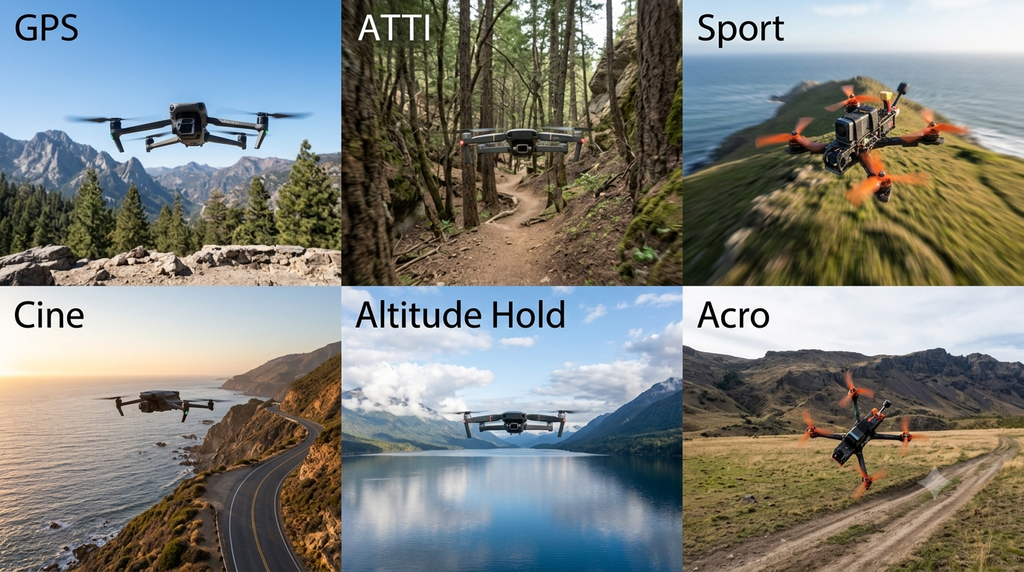
| GPS / Position | Attempts to hold location and altitude | Often suitable outdoors |
| Normal | Balanced assisted flying, model-dependent | Usual starting point |
| Cine / Tripod | Slower, gentler control for video | Useful for smooth filming |
| Sport | Faster or more responsive control, implementation varies | Use after basic practice |
| ATTI | Attitude assistance without reliable horizontal position hold | Requires drift-control skills |
| Altitude Hold | Maintains height, not necessarily location | Expect sideways drift |
| Stabilize | Self-levels, but pilot manages position | Requires practice |
| Headless | Changes directional reference for stick inputs | Orientation aid, not GPS |
| Acro / Rate | Pilot commands rotation rates, usually no self-levelling | Advanced FPV training |
| Return-to-Home | Automated navigation towards a home point | Recovery function, not a guarantee |
Some entries are flight-control modes, while others are control profiles, orientation aids or automated functions. Names and behaviour vary by model.
What Are Drone Flight Modes?
A flight controller combines measurements from inertial sensors and, when fitted, a barometer, GNSS receiver, compass, cameras or range sensors. A mode determines which variables the controller attempts to maintain automatically. Attitude stabilisation controls orientation; altitude hold controls height; position hold controls location. These are separate functions.
A drone can remain level and at approximately the same height while drifting sideways. That is why a feature advertised as stability does not always mean hands-free hovering.
GPS Mode or Position Mode
On suitable camera drones, position-assisted mode uses satellite navigation or other positioning information to detect and correct horizontal displacement. Releasing directional controls can allow the aircraft to stop and hold position. It is often a useful starting point for outdoor beginners.
GPS does not directly stabilise the aircraft or guarantee collision avoidance. When positioning becomes unreliable, some aircraft warn the pilot or change control behaviour. Wind can then produce drift. Learn the documented reduced-positioning procedure for your model. For the underlying technology, read GPS vs Non-GPS Drones.
ATTI Mode: Why Does a Drone Drift?
ATTI means attitude. In attitude-assisted flight, the controller generally helps maintain orientation, but the drone may not hold its horizontal location. Releasing the right stick may level the aircraft without stopping sideways movement. The pilot must correct drift, particularly in wind.
ATTI is not necessarily the same as fully manual Acro control. Not every aircraft has a selectable ATTI mode; some enter reduced-positioning behaviour when navigation data is lost. Do not deliberately practise this in crowded or confined areas.
Normal Mode: Everyday Flight Control
Normal Mode is a balanced operating profile on many consumer camera drones, typically offering assisted control and moderate response. Other brands may call a broadly comparable mode GPS, Position or Standard. The name does not guarantee obstacle avoidance, which depends on the specific aircraft’s sensors and configuration.
Cine Mode and Tripod Mode
On supported models, Cine Mode reduces speed or softens control response to make camera movements smoother. Some older drones offer Tripod Mode with a similar filming objective. Neither name is universal. Slower flight can aid precise framing but does not remove wind, obstacle or positioning risks.
Sport Mode: Faster Does Not Always Mean Better
Sport Mode on many DJI consumer drones increases speed and responsiveness. On certain models, obstacle sensing or avoidance is reduced or unavailable. Faster flight also gives the pilot less reaction time. Sport Mode is not a universal technical standard: ArduPilot has a separately defined Sport Mode with different flight-control behaviour. Always consult the specific aircraft manual.
Altitude Hold Mode
Altitude Hold attempts to maintain height using a barometer or other sensors while the pilot controls horizontal movement. A drone can hold its height yet drift several metres sideways. Budget listings sometimes advertise altitude hold as stable hovering, so verify whether the model also provides horizontal position hold.
Headless Mode
Headless Mode, common on basic drones, interprets directional inputs relative to a stored reference orientation rather than simply the aircraft’s current nose direction. It can help beginners with orientation, but it does not provide GPS, position hold or genuine navigation-based return-to-home. Pilots should still learn ordinary orientation control.
Acro Mode: Advanced Manual Flying
In full Acro or Rate Mode, stick movement commands rotational rates rather than automatically returning the drone to level. It supports advanced FPV manoeuvres but demands substantially more control skill. A simulator and appropriately supervised practice are preferable before attempting it on a physical aircraft. See our FPV Drone Guide for Beginners in India.
Return-to-Home and Autonomous Modes
Return-to-Home attempts to navigate to a recorded home point on supported aircraft. Waypoint missions and other autonomous functions are also available on some platforms. These depend on positioning quality, configuration, battery, weather and obstacles. Know the manufacturer’s interruption and recovery procedures; RTH is not a guarantee of a safe return.
Which Flight Mode Should Beginners Use?
| Situation | Recommended approach |
|---|---|
| First outdoor flight | Manufacturer-recommended Normal or position-assisted mode |
| Smooth video | Cine or equivalent gentle-control profile |
| Basic indoor practice | Low-speed mode on an indoor-capable drone |
| Budget drone practice | Altitude Hold where appropriate; anticipate drift |
| Weak positioning warning | Follow the model-specific recovery procedure |
| Fast manoeuvring | Sport after sufficient practice |
| FPV aerobatics | Acro after simulator training |
| Signal loss | Know configured failsafe and RTH behaviour before takeoff |
These are general guidelines, not substitutes for the manual supplied with your aircraft.
Seven Mistakes Beginners Make With Flight Modes
- Assuming every manufacturer uses the same mode names and behaviour.
- Confusing altitude hold with horizontal position hold.
- Switching to Sport Mode before mastering normal control.
- Assuming GPS prevents collisions.
- Ignoring flight-mode and positioning warnings.
- Treating return-to-home as a guaranteed rescue.
- Learning advanced or reduced-assistance modes in unsuitable locations.
For a practical preflight checklist, see Drone Safety for Beginners in India. If a drone unexpectedly changes behaviour, our DJI Drone Troubleshooting guide may also help identify common warnings.
Drone Flight Modes and Indian Flying Rules
Changing modes does not change a pilot’s legal obligations. Normal Mode does not automatically authorise restricted-airspace flight, and Sport or Acro Mode does not create an exemption. Before flying in India, consult current DGCA requirements and official Digital Sky airspace information. Account for people, obstacles, weather and manufacturer operating limits.
FAQs
What is the safest drone flight mode for beginners?
A manufacturer-recommended assisted mode, such as Normal or GPS Position, is generally a sensible starting point outdoors. Check the manual for your specific aircraft.
What is the difference between GPS and ATTI mode?
Position-assisted flight attempts to maintain horizontal location. ATTI-style control generally maintains orientation without reliable horizontal position hold, so the drone can drift.
Does Sport Mode turn off GPS?
Not necessarily. Some aircraft retain GNSS positioning in Sport Mode. Check model-specific documentation.
Does Sport Mode disable obstacle avoidance?
It does on some models, but not universally. Never assume obstacle avoidance is active.
What is the difference between Cine and Normal Mode?
Cine generally provides gentler, slower control for filming on supported models, while Normal offers balanced everyday response.
Can a drone fly without GPS?
Yes. Many drones can stabilise attitude and hold altitude without satellite positioning, although horizontal position holding may be limited.
Is Headless Mode useful for beginners?
It can simplify orientation on some basic drones, but does not replace learning normal directional control.
Is Acro Mode the same as Manual Mode?
They may describe similar rate-control behaviour, but implementations and training assistance vary by flight controller.
Can I change flight modes while flying?
Many drones support in-flight mode changes, but permitted transitions and control changes depend on the model. Follow its instructions.
Final Verdict: Learn What the Drone Controls for You
Flight modes are not merely speed settings. They determine how much the aircraft does automatically and what the pilot must control. Begin with manufacturer-recommended assisted flight, learn how altitude and position hold differ, and practise reduced-assistance modes only when ready. The most useful skill is knowing what your drone will do when you release the sticks.
