

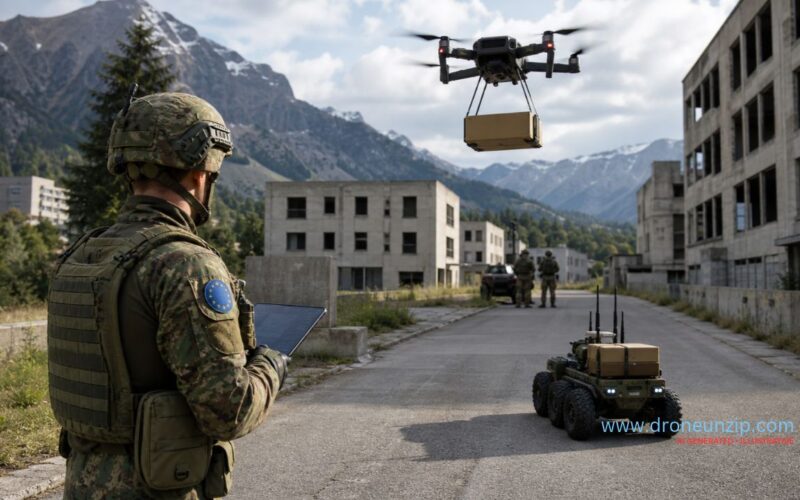
The European Defence Agency and the Swiss Armed Forces have completed a three-day experiment combining aerial drones and unmanned ground vehicles for resupply and casualty evacuation in urban combat conditions. The Alpine Experiment Logistics campaign, known as ALPEX LOG, took place at the Bure military training area in Switzerland from 10 to 12 November, the EDA confirmed.
What happened
The exercise placed wheeled and tracked robotic vehicles in a purpose-built urban training village to evaluate the delivery of supplies to troops near fighting positions and the removal of casualties. Aerial drones carried goods and reconnoitred buildings and surrounding areas, allowing military users to assess how different unmanned platforms could support the same logistics mission.
Swiss military logistics personnel and soldiers from a tank battalion took part alongside European and Swiss companies supplying and operating the equipment. According to the EDA, the field campaign was its first operational experimentation activity outside the European Union.
Operational context and verification
The exercise focused on the final portion of a military supply route, where conventional vehicles can be vulnerable or unable to reach personnel. By testing the systems with combat and logistics units, organisers sought direct feedback on equipment limitations, workflow integration and the practical requirements for future adoption.
ALPEX LOG follows related European experiments in Italy in 2025 and operational experimentation in Portugal during 2026. Switzerland’s participation operates under its cooperation arrangement with the EDA, updated in 2025.
Why it matters and what comes next
The exercise is a test, not an announcement of an equipment purchase or proof that the robots can replace conventional logistics units. The agency has not released independently comparable performance data for individual platforms in the announcement.
The wider opportunity is in coordinated air-ground resupply, casualty evacuation, shared mission planning and interoperable control systems. Military buyers will need evidence that robotic platforms can operate safely around troops, maintain links among buildings and continue missions when navigation or communications are degraded.
For context, DroneUnzip has previously covered European military ground-robot interoperability testing and frontline autonomous ground logistics.
