

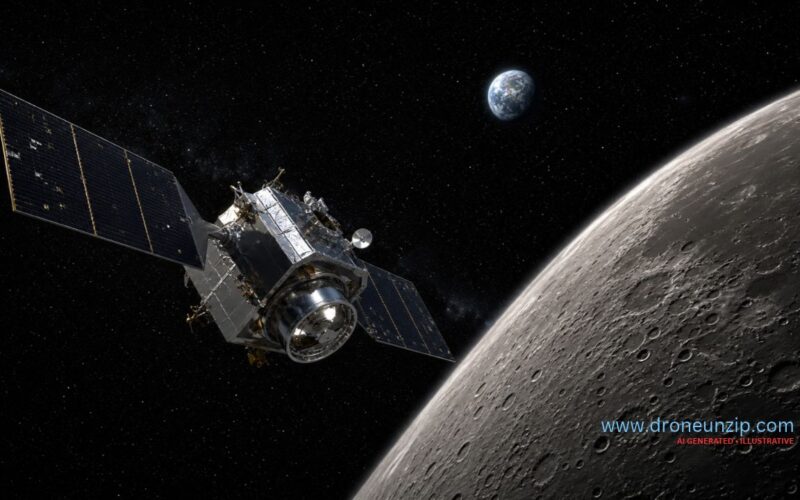
The US Department of the Air Force has requested information from industry about a potential Cislunar Space System comprising up to five spacecraft and the supporting ground infrastructure needed to operate them. The special notice, identified as solicitation 10302026-01, is a market-research exercise rather than a request for proposals or an acquisition award.
What happened
According to the notice, the government is exploring spacecraft buses able to accommodate government-provided payloads, integration and testing, launch arrangements, ground mission management, telemetry, tracking, control and communications, as well as operations and maintenance.
The Air Force says it is notionally interested in up to five space vehicles to meet mission needs in late 2029. These spacecraft could serve as initial vehicles informing a possible future proliferated cislunar constellation. The notice does not commit the government to buying five satellites or building that constellation.
Operational context and verification
The department also indicates that it intends to award up to five firm-fixed-price preliminary design study contracts after reviewing market information. Those potential studies should not be confused with contracts to build and launch the proposed spacecraft.
Responses to the request are due on 24 November 2026, according to the posted notice. The requirements and deadline may change through amendments, so prospective bidders should consult the current official SAM.gov record.
Why it matters and what comes next
Cislunar space extends beyond the operational environment of most Earth-orbiting satellites. Spacecraft in that region face demanding communications, navigation, power and thermal-management constraints. Greater onboard automation may become useful as mission complexity increases, but the publicly described request does not establish a specific autonomous-navigation or AI capability requirement.
The emerging opportunity spans satellite buses, deep-space communications, mission software, ground-segment integration and potentially autonomous fault management. At this stage, those are areas of industry relevance rather than awarded programme work.
For context, DroneUnzip has previously covered DARPA’s automated orbital assembly demonstration and NASA’s robotic payload programme.
