

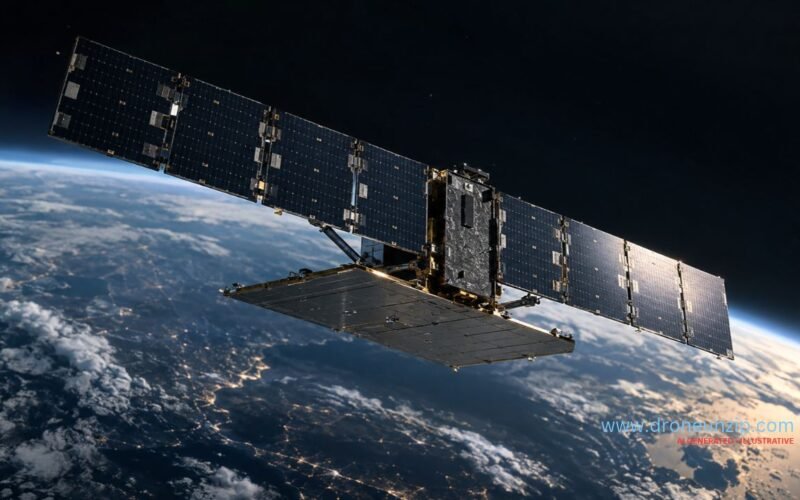
Finnish satellite company ICEYE has introduced its fifth-generation synthetic-aperture radar system, Gen5, with a higher-resolution government imaging mode and onboard computing hardware intended to support future artificial-intelligence processing in orbit.
Key takeaways
- In a 16 November announcement, ICEYE said eligible government users can obtain ground resolution as fine as 11 centimetres using 1,800 MHz of bandwidth, subject to International Telecommunication Union rules. The company lists a 1,200 MHz mode with resolution as fine as 16 centimetres for all customers.
- ICEYE says Gen5 reduces the minimum separation between imaging windows by more than 30 percent and can spend twice as much time imaging per orbit as previous ICEYE satellites. These are manufacturer specifications, not independent comparative test results.
What happened
In a 16 November announcement, ICEYE said eligible government users can obtain ground resolution as fine as 11 centimetres using 1,800 MHz of bandwidth, subject to International Telecommunication Union rules. The company lists a 1,200 MHz mode with resolution as fine as 16 centimetres for all customers.
ICEYE says Gen5 reduces the minimum separation between imaging windows by more than 30 percent and can spend twice as much time imaging per orbit as previous ICEYE satellites. These are manufacturer specifications, not independent comparative test results.
Technical and operational context
The company also says improved orbit control will help satellites observe the same location from a consistent angle, supporting detection of subtle changes across repeated images.
Gen5 includes an AI-ready processor. Screening, preprocessing and tip-and-cue aboard the satellite are described as functions that will be enabled over time through software updates. The announcement does not establish that all those functions are already operating in orbit.
Why it matters and what comes next
Potential applications include maritime monitoring, disaster response and defence intelligence, where reducing the time between observation and actionable information matters. The next evidence to watch is actual Gen5 deployment and validated performance of onboard AI workflows.
