

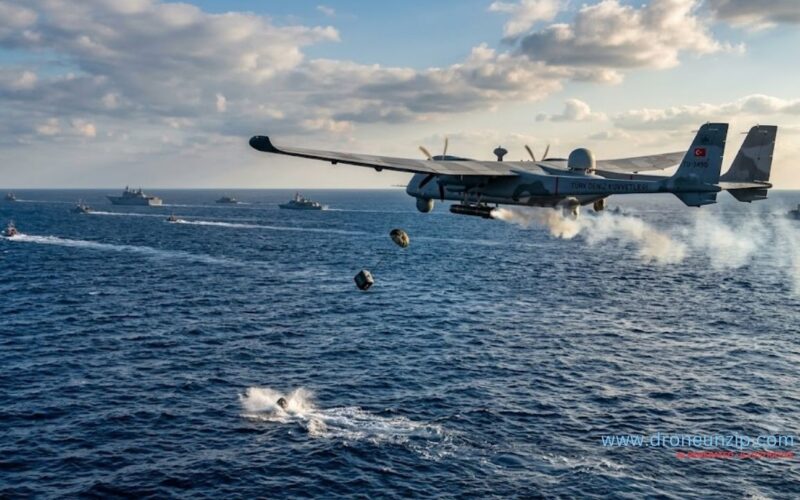
Turkish Aerospace’s Aksungur unmanned aircraft released three ASELSAN aselBUOY 100P passive sonobuoys during the Turkish Navy’s TURNAs-26 exercise in the Mediterranean, demonstrating an airborne-to-underwater sensing chain without a crew aboard the aircraft. Specialist publication Naval News reported the event on 26 October 2026.
Key Takeaways
- Aksungur flew from Ankara to waters off Antalya under satellite control and released three passive sonobuoys.
- The aircraft reportedly remained on station for about four hours, relaying acoustic data to a ground control facility.
- TURNAs-26 brought together unmanned aerial, surface and underwater platforms between 19 and 27 October.
- The exercise does not independently establish combat-ready anti-submarine performance against an operational adversary.
Who Conducted the Aksungur Sonobuoy Demonstration?
Turkish Aerospace supplied the Aksungur aircraft, while ASELSAN developed the aselBUOY 100P passive acoustic sensors. The activity formed part of the Turkish Navy’s TURNAs-26 unmanned systems exercise. Naval News journalist Tayfun Ozberk reported the event on 26 October, drawing on Turkish Aerospace material and exercise reporting.
What Happened During the Maritime Surveillance Flight?
According to Naval News, Aksungur travelled approximately 400 km from Ankara to the Antalya exercise area using satellite communications and its TEI-PD170 engine. The aircraft descended to around 1,000 feet to deploy three sonobuoys, climbed to approximately 6,000 feet and stayed in the area for roughly four hours. Acoustic information was transmitted to a centre connected with the ground control station in Ankara, where the signals were processed.
When and Where Did TURNAs-26 Take Place?
The exercise ran from 19 to 27 October 2026 in the Gulf of Antalya and the Eastern Mediterranean. Naval News reported 41 unmanned systems from 17 defence companies taking part, including aerial vehicles, unmanned surface vessels and underwater vehicles. The sonobuoy sortie was one component of that larger exercise.
What Does the aselBUOY 100P Add to an Unmanned Aircraft?
The aselBUOY 100P is a passive directional acoustic sensor designed to listen underwater and transmit information back to a receiver. India’s parallel investment in underwater systems includes the Indian Navy’s initial deliveries of EyeROV TROUT remotely operated vehicles, although those vehicles perform different tasks from acoustic sonobuoys. Naval News reports a 10 kg NATO A-size unit with selectable listening depths of 30 or 150 metres and a transmission range of up to 20 km. These are reported system specifications, not performance independently measured by DroneUnzip.
Why the Demonstration Matters for Future Naval Autonomy
The significance is the combination of aerial reach, underwater sensing and remote analysis in a single sortie. For the Indian Navy, interoperability is an active topic: its NAUSETU interface-standards initiative addresses how different naval systems can work together. It could support distributed maritime surveillance without requiring a crewed maritime patrol aircraft for every sensor deployment. Turkey had already demonstrated sonobuoy release from the Bayraktar TB3 in September, so the Aksungur sortie should not be described as the first Turkish UAV sonobuoy drop of any kind. For India and other maritime powers, interoperability between unmanned aircraft, surface vessels and underwater sensors is the larger technology trend.
What Remains Unverified?
Public reporting does not establish detection probability, performance against a live adversary submarine, or the effectiveness of a sustained multi-platform network. Future evidence would include repeatable trials, integration with naval command systems and documented operational use.
Sources
Naval News, 26 October 2026 Türkiye Today, 25 October 2026