

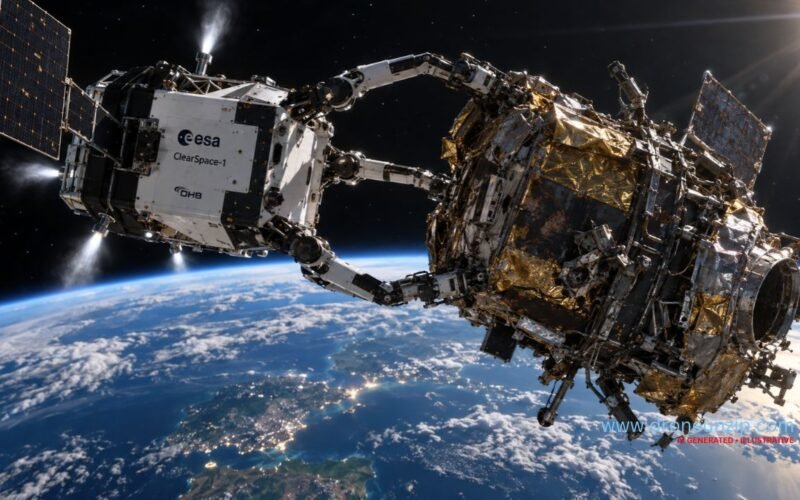
The European Space Agency and prime contractor OHB System AG have formalised the construction phase of the ClearSpace-1 mission. Switzerland-founded ClearSpace has signed an agreement with OHB to supply relative-navigation and robotic capture capabilities within the OHB-led European consortium.
Key Takeaways
- ESA and OHB have advanced ClearSpace-1’s construction, with ClearSpace supplying relative-navigation and capture technologies for a planned PROBA-1 removal.
- ClearSpace-1 is intended to rendezvous with, capture and remove ESA’s PROBA-1 satellite from Earth orbit.
- The partners must complete engineering, integration and qualification before flight.
What will the mission do?
ClearSpace-1 is intended to rendezvous with, capture and remove ESA’s PROBA-1 satellite from Earth orbit. PROBA-1 is an unprepared, non-cooperative target, so the spacecraft must estimate its relative position and motion before a safe capture can be attempted. The mission has not yet demonstrated a successful capture in orbit.
When and where was the agreement signed?
ESA and OHB marked the construction-phase contract at Space Tech Expo Europe in Bremen, Germany, on 17 November 2026. ClearSpace announced its corresponding role on 18 November. The event was a contracting milestone, not a launch or orbital demonstration.
Why autonomous capture matters
Unlike routine docking between cooperative spacecraft, debris removal must account for objects that lack active navigation aids and may be tumbling. Close-range sensing, relative guidance and robotic manipulation therefore become mission-critical. These capabilities also have potential uses in future servicing and inspection, but those commercial applications remain prospective.
What comes next
The partners must complete engineering, integration and qualification before flight. The immediate questions are mission schedule, capture-system test results and how the target’s motion will be handled safely. ClearSpace is also associated with a separate UK mission to remove two defunct satellites; that project should not be confused with ESA’s PROBA-1 target.
